Software QA Audit: What It Checks and How It Works
A software QA audit tells you where bugs are slipping through and what to fix first. Here is what a good audit checks, how it runs, and the report you should get at the end.
- QA-audit
- software-quality-audit
- test-strategy
- QA-process
- QA-testing
A software QA audit is a structured review of how a team tests its product: what gets tested, how, by whom, and what stops a bad build from reaching users. The result is a short report that says where bugs are slipping through and which changes would prevent the most of them, in priority order.
Teams usually ask for an audit at a turning point: customers keep finding bugs, releases keep slipping, a big customer or investor wants evidence of quality, or the team is about to hire QA people or outsource testing and wants to know what to ask for. This guide explains what a good audit covers, how it runs, and what you should get at the end.
What a QA audit is, and what it is not
An audit reviews the testing process and its results. It is not the same as a test pass. A test pass finds bugs in one build; an audit explains why those bugs got that far and how to stop the next ones. Most good audits include a short hands-on test session anyway, because the bugs found in a few hours are the best evidence of where the process is weak.
It is also not a compliance certificate. If you need ISO, SOC 2 or HIPAA evidence, an audit can show where your testing records fall short, but the certification itself comes from an accredited auditor.
Signs you need one
- Customers report bugs before your team finds them, and the number is growing.
- Every release needs a long manual regression, and it is still the step most often skipped.
- Automated tests exist but are flaky, slow or ignored when they fail.
- Nobody can say what is tested before a release, or the answer depends on who is on shift.
- You are about to hire QA staff or a QA vendor and need to know what to ask for.
- A customer, investor or regulator has asked how you assure quality.
The seven areas a QA audit should check
A useful audit looks at the whole path from requirement to production, not only at the test cases. These are the seven areas we review, with the questions behind each one:
- Test strategy and risk: is there a written strategy, and does test effort follow business risk (payments, sign-up, data loss) rather than whatever is easiest to test?
- Requirements and acceptance criteria: can a tester tell from a ticket what correct behaviour is, and are edge cases written down before development starts?
- Coverage: which user journeys, platforms, browsers and devices are tested before release, and which are never tested at all?
- Test automation: what is automated, how stable it is, how long it takes, whether it runs in CI on every change, and whether failures block a merge.
- Bug process: how bugs are reported, ranked by severity, triaged and closed, and how many were found by customers rather than the team.
- Environments and test data: is staging close enough to production, and can testers create the accounts, payments and data they need without waiting on developers?
- Release gates and monitoring: what has to pass before a release, who signs off, how fast a bad release can be rolled back, and whether errors in production are noticed before customers write in.
Specialist areas such as performance, security and accessibility are usually checked at a high level in a general audit (is anything tested at all, and against what standard), then covered properly in a separate test if the audit shows a gap.
How the audit runs
- Scoping call: agree the product areas, platforms and goals, and who the auditor can talk to.
- Document and tool review: test plans, recent tickets, the bug tracker, CI pipelines and the automation repository.
- Interviews: short conversations with a developer, a product owner and whoever tests today, to learn how work actually flows.
- Hands-on session: a few hours of exploratory testing on the most important journeys, to see where real bugs are.
- Findings and report: each finding with evidence, impact and a recommended fix, ranked by priority.
- Walkthrough: a call to go through the report and agree the first changes.
For a single product, a focused audit takes days rather than weeks. Larger platforms with several apps and teams take longer, mainly because there are more people to talk to and more pipelines to read.
What the report should contain
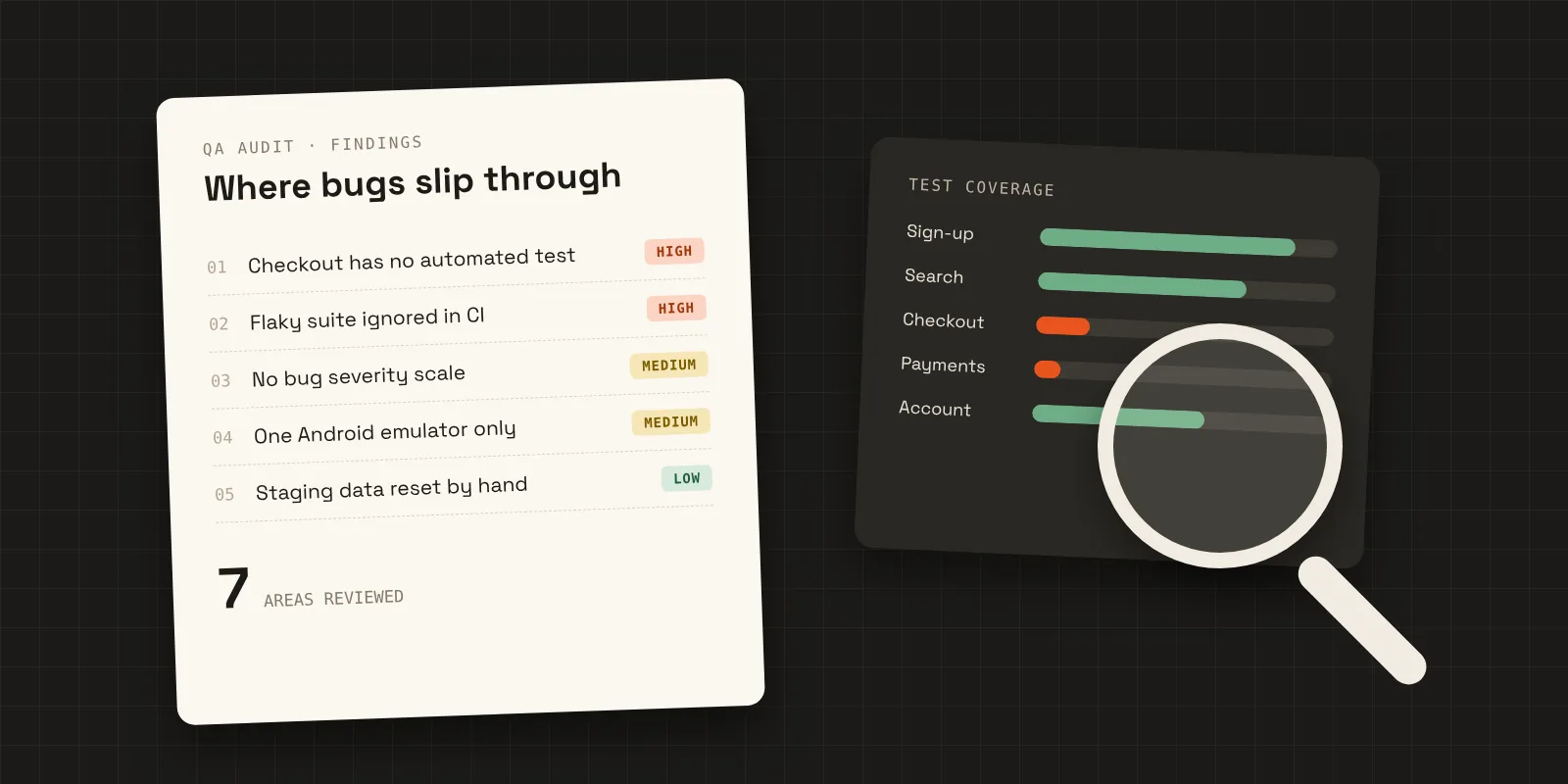
A good report is short enough that a busy founder or CTO reads all of it. Each finding should state what was observed, the evidence, why it matters, and the recommended change. A sample findings table looks like this:
| Finding | Evidence | Impact | Priority |
|---|---|---|---|
| Checkout not covered by any automated test | No test in the suite touches payment; last 3 payment bugs found by customers | Revenue loss and refunds | High |
| Automated suite ignored in CI | 14% of runs fail on flaky tests; merges continue on red | Real failures are missed | High |
| No severity scale for bugs | Similar bugs ranked differently by different people | Critical bugs wait behind cosmetic ones | Medium |
| Android tested on one emulator only | Crash reports from older Samsung devices | Bad reviews, uninstalls | Medium |
| Staging data reset by hand | Testers wait a day for fresh accounts before each release | Slower releases | Low |
The table above is an illustration of the format, not data from a client. Alongside the findings, expect a short roadmap: what to fix in the next two weeks, the next quarter, and later.
A self-check you can run today
Before you book an external audit, answer these ten questions honestly. Every "no" is worth a closer look:
- Strategy: do we have a written test strategy that names our riskiest features?
- Tickets: does every ticket say how to tell that it works, before development starts?
- Regression: is there a regression checklist or suite that runs before every release?
- Automation: do automated tests run on every pull request, and does a failure block the merge?
- Flakiness: do we fix or remove flaky tests within a week?
- Devices: do we test on the browsers and devices our analytics say customers use?
- Bugs: do we track how many bugs customers find versus the team, every month?
- Severity: does everyone use the same severity scale?
- Data: can a tester create a fresh account, order or payment in staging in minutes?
- Release: is there a named person who signs off each release, and a rehearsed rollback?
Internal or external audit?
Your own team knows the product best, and the self-check above is a good start. An external auditor adds two things: an outside view that isn't shaped by how things have always been done, and comparison with many other teams' processes. For investor or customer due diligence, an independent report also carries more weight.
QA Labs runs a short written audit as the free starter for every QA engagement: a scoping call, a review of your most important user journeys and a list of the issues to fix first. If the audit shows larger gaps, we can run a full pre-launch QA audit or set up the testing it recommends.
Key takeaways
- A QA audit explains why bugs reach users and which changes prevent the most of them
- Review seven areas: strategy, requirements, coverage, automation, bug process, environments and release gates
- Expect evidence for every finding, ranked by priority, plus a short roadmap
- Run the ten-question self-check before paying for an external audit
- An independent audit carries more weight for investors, customers and regulators
Free QA spot-check
Want a QA engineer to look at your product?
Send us your website or web app address. An engineer will test one key journey, such as sign-up, search or checkout, on desktop and mobile, and email you the most important issues we find. Free, and no call needed.
Related service
QA Testing →Automated suites, manual deep-dives, and CI guardrails that catch regressions before your users do.
Further reading
About the author
Kawsher, Founder, QA Labs →Kawsher is the founder of Quality Assurance Labs (QA Labs), the QA-first software testing and development company in Bogura, Bangladesh, founded in 2021. Every article and case study on this site is written or reviewed by Kawsher, drawing on the team's QA testing, AI, web, mobile, video and marketing work for SaaS and AI teams worldwide.