QA Outsourcing Cost in 2026: Rates, In-House vs Outsourced
What outsourced QA costs per hour, what an in-house QA engineer really costs, and how to compare the two on the same basis.
- QA-outsourcing-cost
- QA-outsourcing
- software-testing-cost
- QA-pricing
- QA-testing
Short answer
QA outsourcing is usually priced per hour: Upwork's cost guide puts QA engineers at $20 to $60, and QA Labs charges $15 to $25. A US in-house QA engineer costs about $149,000 a year in wages and benefits at the national median. Compare quotes on the hours each release needs, not on rates alone.
Key takeaways
- Outsourced QA is usually billed hourly; Upwork's cost guide shows $20–$60 an hour for QA engineers
- A US in-house QA engineer costs about $149,000 a year in wages and benefits at the national median
- Compare options on the same basis: hours per release, and what the rate includes
- Pick the pricing model by workload: hourly for uneven demand, projects for launches, a monthly team for frequent releases
- Compare the cost of a release your team trusts, not the hourly rate
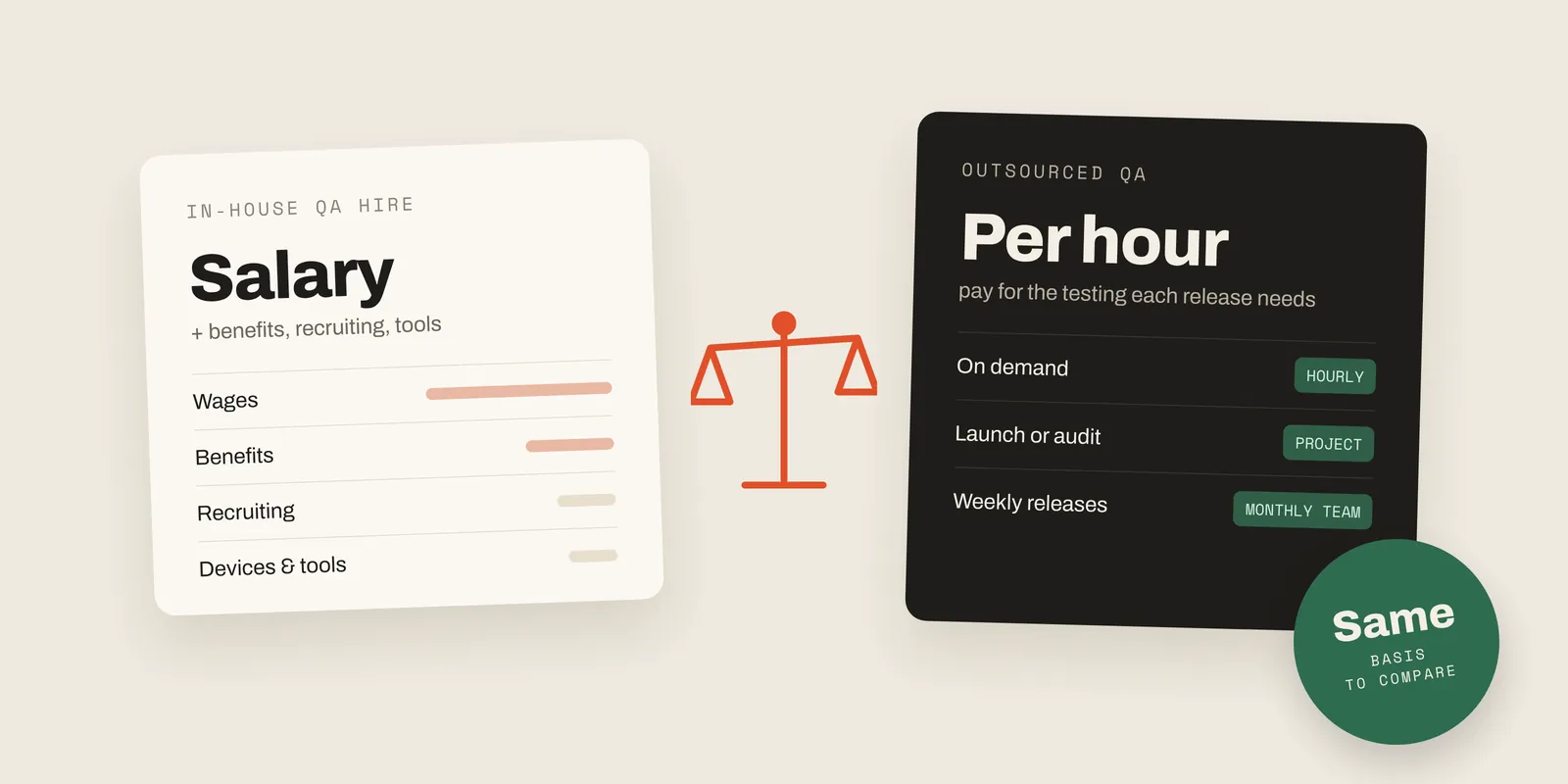
Most teams ask what QA outsourcing costs right after they have priced an in-house hire. The two numbers are hard to compare: a salary covers one person for a year, while outsourced QA is usually billed by the hour, by the project or as a monthly team. This guide puts them on the same basis, using public salary data and the hourly rates we publish ourselves.
All figures are in US dollars. Salary and benefit figures come from the US Bureau of Labor Statistics; marketplace rates come from Upwork's own cost guide. Our rates are the ones on our pricing page, and they are the same in this article as there.
How much does QA outsourcing cost?
Outsourced QA is usually priced per hour. Upwork's cost guide puts QA engineers on its marketplace at $20 to $60 an hour. At QA Labs, QA testing is $15 to $25 an hour, with $20 as our standard rate. Fixed-price projects and dedicated monthly teams are quoted after a free scoping call, so they are not listed here.
Hourly rates hide the real question, which is how many hours a release needs. A small product with one web app and a monthly release might need a few days of testing per release. A product with web, iOS and Android apps and weekly releases may need a full-time tester or more.
What does an in-house QA engineer cost?
The US Bureau of Labor Statistics reports a median annual wage of $104,300 for software quality assurance analysts and testers in May 2025. Wages are not the whole cost: in June 2026, benefits made up 30.0% of private-industry employers' compensation costs, and wages the other 70.0%.
If a QA engineer's pay follows that national average split, a $104,300 salary means total compensation of about $149,000 a year ($104,300 ÷ 0.70). That is before recruiting, equipment, test tools, device access and the time a manager spends running QA. These are national averages, so salaries in your city and the benefits you offer will move the figure up or down.
In-house or outsourced: the cost side by side
The table puts each option on the same basis: 2,080 paid hours a year, which is 40 hours a week for 52 weeks. It compares cost only; the sections below cover what each option includes.
| Option | Basis | Approximate yearly cost for 2,080 hours |
|---|---|---|
| In-house QA engineer (US median) | $104,300 wage plus benefits at the national average share | About $149,000, before recruiting, tools and devices |
| Freelance QA on Upwork | $20–$60 per hour (Upwork cost guide) | $41,600–$124,800 |
| QA Labs, starting rate | $15 per hour | $31,200 |
| QA Labs, standard rate | $20 per hour | $41,600 |
| QA Labs, premium rate | $25 per hour | $52,000 |
Few teams need a full-time tester from day one. If your product needs 80 hours of testing a month, the same arithmetic gives $1,600 a month at our standard rate, and you can scale hours up for launches and down between them.
What is not included in an hourly rate?
An hourly rate buys testing time. Before comparing quotes, check what else the work needs and who pays for it:
- Devices and browsers: real phones and device-cloud access for mobile testing.
- Tools: test management, bug tracking and CI minutes for automated suites.
- Onboarding: the first weeks, when testers learn your product and write the first test cases.
- Specialist work: performance, security and accessibility testing often need more senior people.
- Your team's time: developers answering questions, reviewing bug reports and fixing what is found.
Ask each vendor which of these are in the rate and which are extra. A lower rate with paid onboarding and device fees can cost more than a higher rate that includes them.
Which pricing model should you choose?
Outsourced QA is sold in three ways, and the right one depends on how steady your workload is.
| Model | How it is priced | Best for |
|---|---|---|
| Hourly or on demand | Hours used, billed weekly or monthly | Uneven workloads, beta tests, quick checks before a release |
| Fixed-price project | One quote for an agreed scope | Launches, audits and one-off test cycles with a clear scope |
| Dedicated monthly team | A monthly fee for named testers | Products that release every week or two and need the same people every time |
Teams often start with a project, such as a pre-launch test cycle or a QA audit, then move to hourly or a dedicated team once they know how much testing each release needs.
What makes QA outsourcing expensive?
The rate is rarely the problem. These are the patterns that raise the total cost of QA, whoever does it:
- Testing everything manually on every release, when the stable core could be automated.
- Testers who report many low-value issues, so developers spend hours triaging instead of fixing.
- No written test strategy, so coverage depends on who happens to be testing.
- Changing testers often, so every new person has to learn the product again.
- Starting QA a week before launch, when bugs are most expensive to fix.
This is why we suggest comparing the cost of a release your team trusts, not the hourly rate. Our QA outsourcing guide covers how to compare vendors in more detail.
How to get an accurate quote
Send vendors the same short brief, so the quotes are comparable:
- The product: web, iOS, Android or API, and a link or test build.
- How often you release, and what must never break (payments, sign-up, data).
- Browsers, devices and OS versions your users have, from your analytics.
- What exists today: test cases, automated tests, CI and bug tracker.
- Your deadline, if there is a launch date.
Every QA engagement with us starts with a free scoping call and a short written audit, with a recommended plan and a quote. You see how we work before you pay for anything.
Frequently asked questions
Is offshore QA cheaper than in-house QA? — Usually, yes, on hourly cost. Using the figures above, a US in-house QA engineer costs about $149,000 a year in wages and benefits at the national median, while 2,080 hours at our standard rate is $41,600. The saving only holds if the outsourced team finds the important bugs and reports them clearly.
Is test automation more expensive than manual testing? — Automation costs more to build and less to run. A suite takes time to write and maintain, then runs on every release at little extra cost. Manual testing is cheaper to start, but its cost grows with every feature you add. Most products need both: automation for the stable core and manual testing for new features and judgment calls.
Can I outsource QA for just one release? — Yes. A fixed-price project or a block of on-demand hours suits a single launch, a beta or an audit. Many teams start this way before deciding whether they need ongoing QA.
Free QA spot-check
Want a QA engineer to look at your product?
Send us your website or web app address. An engineer will test one key journey, such as sign-up, search or checkout, on desktop and mobile, and email you the most important issues we find. Free, and no call needed.
Related service
QA Testing →Automated suites, manual deep-dives, and CI guardrails that catch regressions before your users do.
Further reading
About the author
Kawsher, Founder, QA Labs →Kawsher is the founder of Quality Assurance Labs (QA Labs), the QA-first software testing and development company in Bogura, Bangladesh, founded in 2021. Every article and case study on this site is written or reviewed by Kawsher, drawing on the team's QA testing, AI, web, mobile, video and marketing work for SaaS and AI teams worldwide.